Nirala journal · Art & tradition
What Is Madhubani Painting? A Beginner’s Guide to Mithila Art
Explore the traditions, lines and colours of Madhubani painting. This introduction to Mithila art includes a Ganesh artwork, two approaches to mark-making and a small exercise to help you begin.
By Nirala Studio · 6 min read · 5 November 2026
Updated 12/11/2026
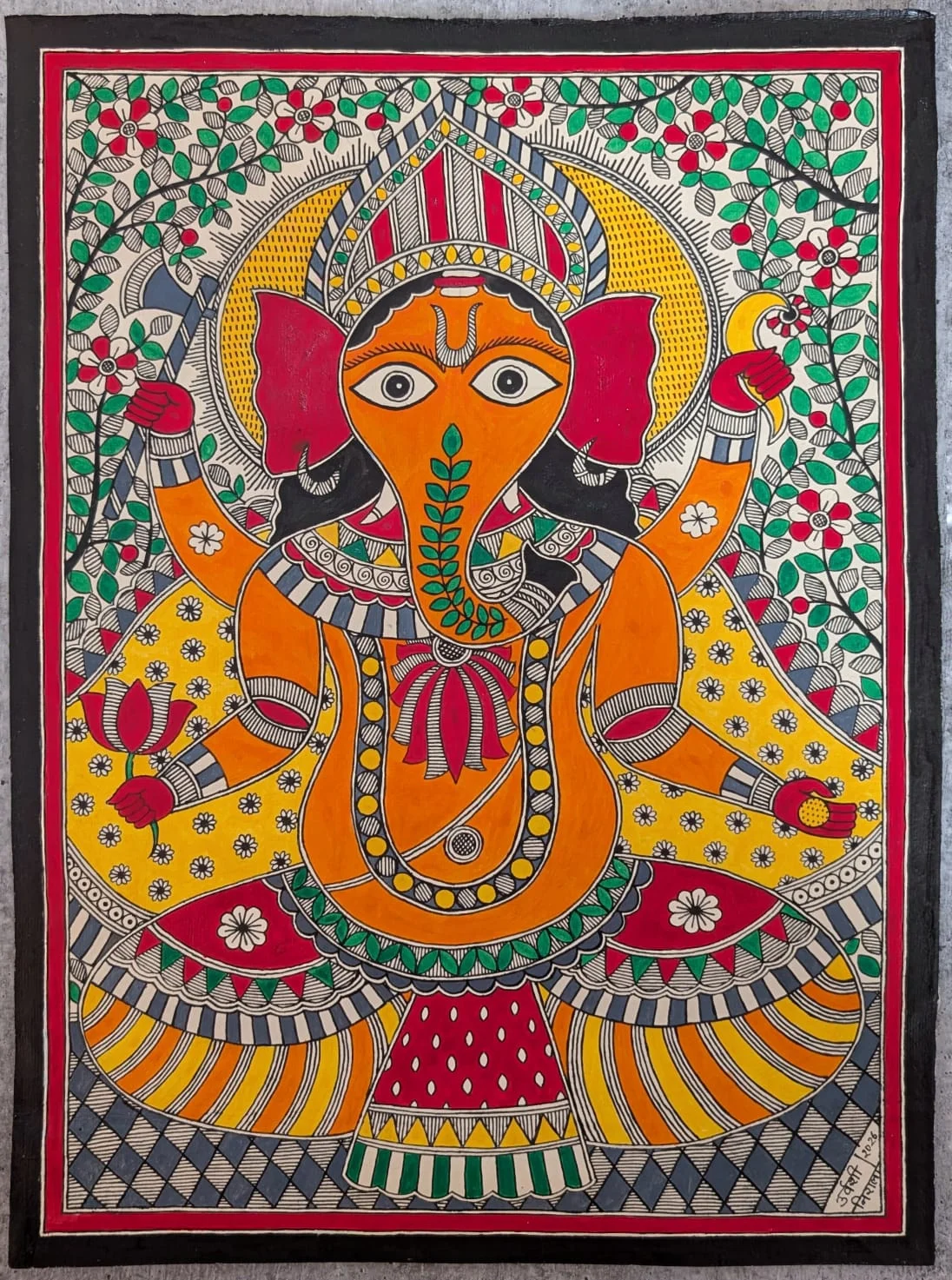
Madhubani or Mithila art, is a centuries old folk art from Mithila region of Bihar and border areas of Nepal touching the region. This traditional art was originally started by women, who painted them on mud walls of homes in villages for weddings, rituals and festivities.
What is Madhubani or Mithila Art?
Imagine walking in the courtyard of a house where the outer and inner walls are not just merely the combination of colors with few paintings and decorations hanging, instead speaking with the help of art drawn on them clearly defining their own individuality and purpose. This is the story about Mithila art.
For centuries houses in the state of Bihar had spoken the language of this vibrant art which had been drawn to celebrate and observe traditions and culture.
Women would plaster their mud walls with clay and cow dung, pick up a handful of twigs and paint stories of love, nature, festivals and even mythological characters.
The world of Madhubani painting is a visual treat and language of its own which had travelled right from the small courtyards of houses in villages to international art galleries.
Where Did Madhubani Begin?
The history of the art takes us back to the ancient mythology of Ramayana.
When Princess Sita was getting married to Prince Ram, her father, King Janak of Mithila (in Northern Bihar), wished to have the celebration all over his kingdom and hence ordered all the villagers to paint the walls of their homes with vibrant designs to welcome the groom.
The women painted stories of love, nature, and gods. That tradition never stopped.
Ever since then women in Mithila continued painting on the walls and floors of their homes for every important moment, whether a birth, a wedding, a festival like Chhath, a new beginning.
Mithila art was never called "art" then, but was called Shubh, meaning auspicious. For Biharis, Madhubani art has never been art but a prayer you could see through different paintings in different mediums.
Then came 1970s, when Bihar faced the drought year, it was the time when the government encouraged these women to paint on paper so their art could be sold. That is how the world discovered Madhubani.
Madhubani Painting also has another name
Before it was called Madhubani painting, locals called it Likhiya, which means to write or draw. This is because women drew long, steady lines by hand without any scale and since most paintings told a story or a blessing, painting on the wall felt like writing down a prayer.
What makes a painting Madhubani/Mithila art?
If you want to recognize Mithila art, we need look at these points:
- No Empty Space: In this folk art there remains zero empty space. Every gap is filled with tiny dots, lines, motifs or patterns. This method represents the idea that life is full and there is no space for any negative energy.
- Double Borders: Madhubani figures are almost never drawn with a single stroke. Artists outline everything twice. The tiny gap between these two lines is then filled with delicate, hypnotic parallel lines or cross-hatching or sometimes left empty as well.
- Motifs That Tell a Story: In this traditional art, nothing is mere drawing and decoration, every design or motif has deep meaning behind it.
- Fish-Eyed Profiles: Humans, gods, and animals are traditionally drawn in sharp side-profiles. They feature prominent noses and massive, expressive, fish-shaped eyes that seem to look right through you.
- And the figures: They are always flat, in side profile, with large expressive eyes. We don't paint shadows or 3D perspective in Madhubani. We paint what we feel and not what we see.
The Two Main Styles: Kachni and Bharni
This is where most beginners get confused, but as we start learning we understand that:
- Bharni (Filled Style): The figures are completely colored and filled with bright colors, mostly the primary ones- red, yellow, green, blue.
- Kachni (Line Style): In this style there is no colour filling. The entire beauty comes from fine, delicate lines. Dots, cross-hatching and thin strokes create the pattern.
What Colours Were Traditionally Used?
We know that this art goes way back to the era and region where commercialism and materialism had no existence of any sort. Thus, while Madhubani art was highly practiced in the houses, the women would create colors for it right from their own houses.
They looked around their kitchens and backyards to create a brilliant, completely organic color palette.
- Yellow was extracted by crushing raw turmeric or marigold petals.
- Black was made by collecting the soot from mustard oil lamps and mixing it with cow dung.
- White came from a paste of rice flour and water.
- Red and Brown were derived from local clay or the juice of pomegranate.
And while the palette had its own way, women instead of paint brushes used whatever medium was handy for them in order to draw.
Right from sharpened bamboo twigs to matchsticks to even their own fingers, the artist would give the art their own definitions and finesse.
How To Start Madhubani As a Beginner?
You don't need to be an artist to start, but can try instead with the following:
- Step 1: Get the right tools- A 0.5 black pen, a red pen and a cartridge sheet or any handmade paper (optional for beginners).
- Step 2: Practice borders first- Don't jump drawing a whole painting but start with practicing straight lines- both horizontal and vertical, dots and the classic double-line border.
- Step 3: Learn to draw basic motifs- Start with animals, nature, birds etc which are commonly seen in basic Madhubani paintings.
- Step 4: Make one small composition- Make a small 4x4 inch piece, drawing animal or bird in the middle along with a border around it. Fill all empty space with small patterns or dots etc.
Why Madhubani Matters Today
Earlier, life of Madhubani was only limited to mud walls, but today, it is recognised and created on paper, sarees, dupattas, home decor, posters and even digitally.
Every time a woman picks up a brush to paint Madhubani, two things happen: She earns her own independence, and she keeps a centuries-old Indian heritage alive.
So if you want to keep the tradition alive and learn more about this folk art, connect with Nirala Studio and join the community where expertise is not just limited to paint a composition but to allow yourself enter the world which takes you back to the culture and helps you add your creativity and modern twist to it.
Take the next step